
Blood flow restriction therapy might sound high-tech, but it's actually simple and powerful. Imagine gaining muscle strength with just light weights. That's exactly what this method offers injured athletes and anyone who can't lift heavy. As we move through 2025, this training method is becoming a top choice in sports rehab. Let's explore how it works and why it's changing the game for athletes.
What Is Blood Flow Restriction Therapy?

Blood flow restriction therapy (also called BFR or occlusion training) uses a special cuff or band on your arm or leg during exercise. The cuff partially restricts blood flow to your working muscles.
Here's the amazing part: you can lift only 20-30% of your normal weight and still see huge gains. According to research from Frontiers in Public Health, low load blood flow restriction training at 20-40% of your 1-rep max can match the muscle and strength gains of heavy training at 70% or more. Your body thinks you're lifting heavy when you're not.
This makes blood flow restriction therapy perfect for rehab settings. You get a strong muscle-building effect without the joint stress of heavy weights. The American Physical Therapy Association notes that BFR training helps patients make greater strength gains with lighter loads while reducing stress on the limb.
How Does Low-Load BFR Training Work?
The science behind blood flow restriction therapy rehab comes down to muscle stress. When you exercise with the cuff on, your muscles become semi-ischemic (low oxygen). This causes a buildup of metabolites like lactate.
The low-oxygen environment leads to increased growth hormone release, fast-twitch muscle fiber recruitment, and cellular swelling. Your body responds as if you're pushing to your max, even with light weight. Research shows that adding BFR to low-load exercise produces hypertrophy and strength gains using loads as low as 30% of your 1-rep max. Meanwhile, the lighter loads mean less wear on joints and tissues.
Benefits of BFR for Sports Rehab and Strength Gains
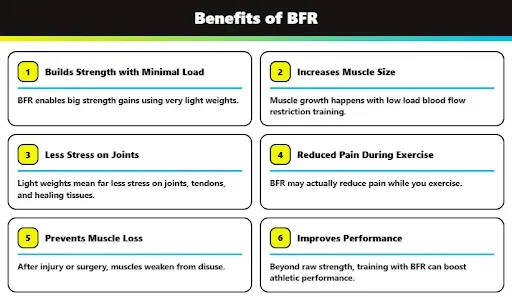
Blood flow restriction therapy offers major advantages for athletes and rehab patients. Here are the key benefits of a sports rehab blood flow restriction program:
Builds Strength with Minimal Load
BFR enables big strength gains using very light weights. A systematic review in Arthroscopy Journal found that in 58% of studies on athletes, BFR groups saw greater strength increases than groups training without BFR.
Increases Muscle Size
Muscle growth happens with low load blood flow restriction training. The metabolic stress during occlusion exercise promotes hypertrophy. Multiple studies show that BFR leads to muscle size gains equal to traditional heavy training.
Less Stress on Joints
Light weights mean far less stress on joints, tendons, and healing tissues. BFR provides a strength stimulus for muscles while sparing joints from high forces. This makes it ideal for people with arthritis, post-surgery patients, or anyone where heavy loads could cause problems.
Reduced Pain During Exercise
BFR may actually reduce pain while you exercise. In one study from Frontiers in Public Health, athletes with chronic low back pain used low-load BFR for four weeks and saw significant pain reduction. They also got similar strength gains as heavy-load training.
Prevents Muscle Loss
When you're injured and can't lift heavy, muscle atrophy happens fast. BFR fights this. Using light loads with restriction keeps muscles active and minimizes loss. This is crucial in early rehab when tissues are too vulnerable for heavy training.
Improves Performance
BFR isn't just for rehab. Healthy athletes use it to build strength and muscle efficiently. A study in the Journal of Science and Medicine in Sport found that after just three weeks of BFR training with walking, athletes improved jump and sprint performance. Integrating BFR can give you an edge in competitive sports.
Integrating Blood Flow Restriction Therapy into Rehab

Blood flow restriction therapy works best when paired with a complete rehab approach. At AthleteRx Rehab, we combine BFR with corrective exercise and sports manual therapy to optimize your recovery.
Corrective Exercise: We identify movement flaws and muscle imbalances that might have contributed to your injury. Corrective exercises retrain your body for proper mechanics. Combined with BFR, this ensures you rebuild strength on a solid movement foundation.
Sports Manual Therapy: This includes hands-on techniques like joint mobilization, soft tissue work, and myofascial release. Manual therapy reduces pain, restores range of motion, and prepares tissues for exercise. When paired with BFR, you get both the mobility and the strength needed for a full recovery.
By combining these approaches, you get a holistic sports rehab blood flow restriction plan tailored to your needs. This integrated method addresses all aspects of your injury for the best possible outcome.
If you're ready to experience the benefits of blood flow restriction therapy, working with a qualified professional is key. At AthleteRx Rehab, our trained therapists use evidence-based BFR protocols in a safe, supportive environment.
Build Strength Smarter with BFR
Blood flow restriction therapy offers a revolutionary way to build strength and muscle with light loads. Whether you're recovering from injury, managing chronic pain, or looking to enhance performance, BFR provides powerful results without the stress of heavy training.
Combined with corrective exercise and sports manual therapy, blood flow restriction therapy becomes part of a complete rehab strategy that addresses all your needs. The science is clear: BFR works, and it's changing the way athletes and active people recover and perform.