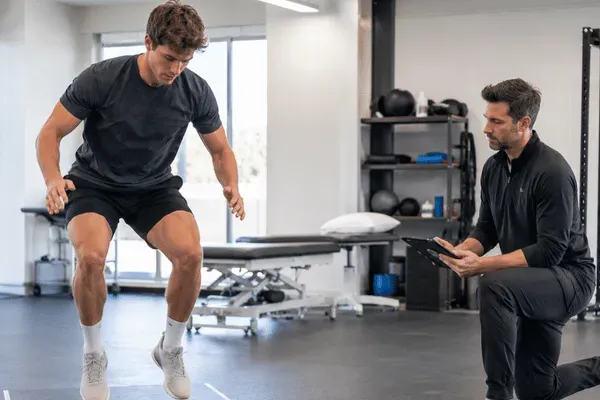
Feeling no pain after an injury is a great sign but it is not enough to know you are ready to play. Return to sport testing gives athletes, parents, and coaches a clear, objective answer to the question everyone is asking: Is it safe to go back? At AthleteRx Performance Rehab, we use a full battery of tests to answer that question with real data, not guesswork.
What Return to Sport Testing Actually Means
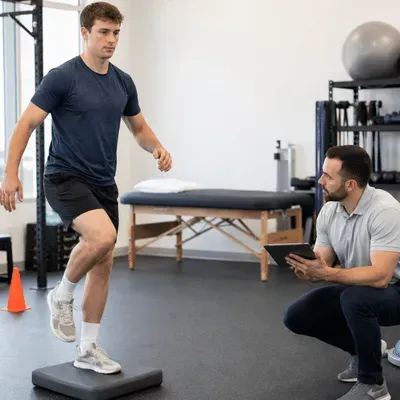
Return to play testing is not one test. It is a full picture.
Recovery moves through three stages:
- Return to participation (light activity, no contact)
- Return to sport (full practice, sport-specific drills)
- Return to performance (competing at full game speed)
Sports readiness testing looks at where you are across all three. It combines your symptoms, strength, movement quality, mental confidence, and sport-specific demands. The 2016 World Congress in Sports Physical Therapy established this continuum as the standard for athlete return to sport assessment.
No single number clears an athlete. A good clinician looks at the whole picture.
What a Good Testing Battery Includes
A strong return to sport testing battery covers these areas:
Clinical Status
Before any physical testing begins, your body needs to clear the basics. That means no pain, no swelling, and a full range of motion. You also should not feel any instability in the joint during daily movement. These are necessary first steps, but they are not enough on their own to say you are ready.
Strength Testing
Strength is an important aspect in return-to-sport testing. Clinicians evaluate quadriceps and hamstring strength in both legs and compare the results. A usual standard is at least 90% symmetry between the injured and healthy sides. Some conservative late-stage protocols raise that threshold to 95% or more before releasing an athlete for full recovery.
Hop Tests
The hop battery contains four tests: single hop, triple hop, crossover hop, and 6-meter timed hop. Distance and time scores are important, but so is the way you land. A good score combined with weak knee control is hardly a pass. During each test, clinicians look for knee collapse, adjustment, and braking behaviors.
Movement Quality
This section focuses on how you move, rather than how far or fast you go. Drop jump and single-leg squat tests are used to identify valgus collapse, poor hip control, and poor braking mechanics. An athlete can achieve solid numbers on paper while also exhibiting movement patterns that increase the likelihood of reinjury.
Balance and Control
The Y-Balance test determines how effectively you can stabilize and control your body on one leg. Single-leg stability drills provide additional context for joint control under stress. These tests are especially beneficial for detecting impairments that strength and hop scores alone may overlook.
Psychological Readiness
Fear of reinjury is real, and it affects how athletes move, whether they realize it or not. The ACL-RSI questionnaire measures confidence and readiness to return from the athlete's own perspective. Many clinical protocols require a score of 80 or higher before clearing someone for full sports activity.
Patient-Reported Function
How you feel about your knee is part of the data. IKDC and KOOS scores capture your own assessment of function, pain, and sport readiness. These scores should line up with your physical test results. A big gap between how you feel and how you test is a signal worth examining before clearing you to play.
Common Reasons Athletes Fail When They Should Still Pass
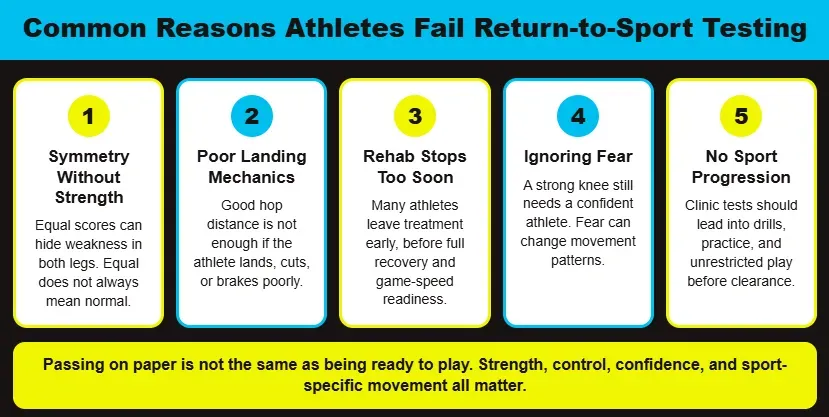
According to research, passing a test does not always indicate that you are prepared. These are the most prevalent gaps:
Symmetry without strength. Equal scores on both legs can conceal bilateral weakness. Equal may not always imply typical.
Good hop distance, but poor landing mechanics. How you land and cut is as important as how far you jump. A 2025 review published in the Knee journal indicated that this gap is prevalent.
Stopping rehab too soon. Many athletes leave official treatment after six to seven months. The majority do not reach full capacity until 9-12 months.
Ignoring fear: A strong knee without full confidence is not full readiness. Fear of reinjury changes how you move, even if you do not notice it.
No sport-specific progression. Clinic tests do not fully replicate practice or competition. You should progress from drills to practice to unrestricted play before full clearance.
How Timelines Fit In
Time matters. But time alone is not enough.
Research by Beischer et al. (2020) found that athletes returning to knee-heavy sports before 9 months had higher second-injury rates. A 2025 study by Kotsifaki et al. found that in male athletes who fully met objective criteria, returning slightly before 9 months did not raise risk. The takeaway: criteria matter more than the calendar.
For youth athletes, guidelines stay conservative. Pediatric orthopedic doctors and sports physical therapists recommend 9 months or more, along with extra caution across the board.
Ready to find out where you actually stand? Book a formal return to sport testing evaluation at AthleteRx Performance Rehab. We will test what matters, explain your results, and build a clear plan from where you are now to full game-speed performance.
The Bottom Line
Return to sport testing takes the emotion out of a hard decision and gives athletes a clearer path back to practice, training, and full game-speed performance. At AthleteRx, athletes work with Board-Certified and Fellowship-Trained Sports Physical Therapists, including Dr. Ben Volkman, PT, DPT, SCS, FAAOMPT, CSCS, who brings 10+ years of experience and pro-level rehab methods used with NFL, MLB, NBA, and Olympic athletes.
Do not guess your way back into sport. Schedule a return to sport testing evaluation at AthleteRx Performance Rehab and get the data, plan, and expert guidance you need to return to sport.