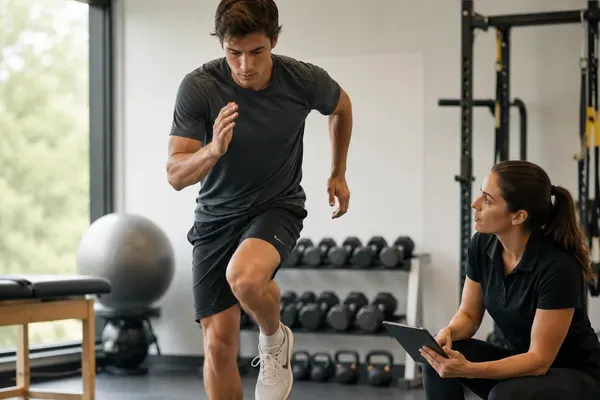
Cleared for sport is not the same as feeling better. Return to sport testing is specifically intended to bridge that gap. Many athletes return to their sport after receiving rehabilitation, feel strong, and then get another injury. The majority of clinics still rely on time plus simple strength tests, according to a 2025 scoping analysis published in The Knee Journal. That combination is insufficient on its own.
At AthleteRx Performance Rehab, we use a full, criteria-based approach. We look at strength, movement, confidence, and sport-specific performance, not just pain levels.
What Return to Sport Testing Actually Means
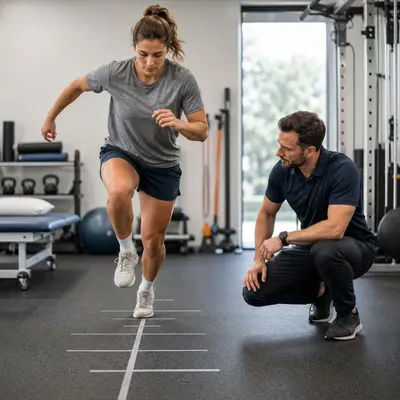
Return to sport testing is a multi-domain assessment. It checks whether an athlete has the physical capacity, movement control, and mental readiness to progress safely.
There are three distinct stages, and they are not the same:
- Return to participation: adjusted training and load monitoring.
- Return to sport: unrestricted practice and competition clearance.
- Return to performance: full load tolerance and output from before the injury are restored.
Passing a test does not mean you are fully restored. It means you are ready for the next stage. That distinction matters.
What a Complete Return to Sport Testing Battery Includes
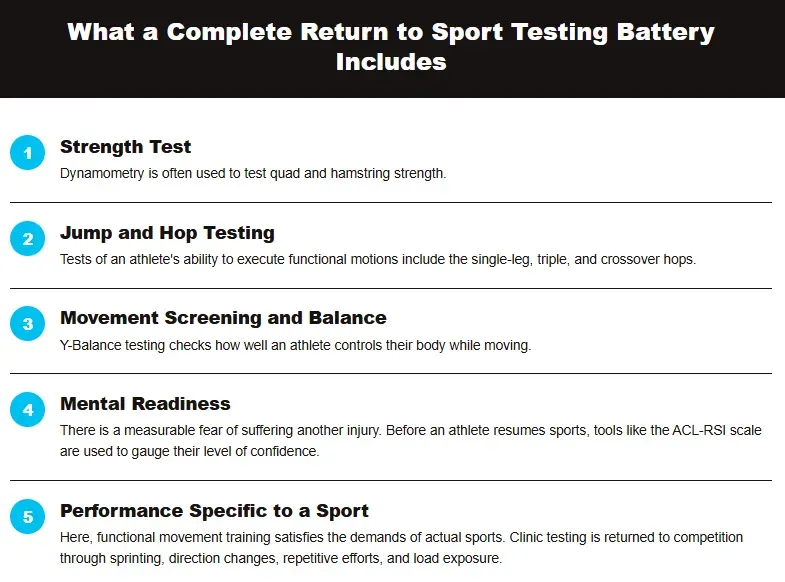
Good performance rehab is not a one-number game. A full battery is multidomain.
Strength Test
Dynamometry is often used to test quad and hamstring strength. At AthleteRx, we utilize Keiser performance equipment to assess the power output of your quadriceps and hamstrings. Results should be reported as absolute values, not just limb symmetry, because your "good" leg may have lost strength too.
Jump and Hop Testing
Tests of an athlete's ability to execute functional motions include the single-leg, triple, and crossover hops.
Movement Screening and Balance
Y-Balance testing checks how well an athlete controls their body while moving. Video analysis can also show risky movement patterns, such as the knee dropping inward, stiff landings, or poor control during cuts and direction changes.
Mental Readiness
There is a measurable fear of suffering another injury. Before an athlete resumes sports, tools like the ACL-RSI scale are used to gauge their level of confidence. Low confidence ratings may indicate that the athlete has a lower chance of making a full recovery, even if the physical test results appear positive.
Performance Specific to a Sport
Here, functional movement training satisfies the demands of actual sports. Clinic testing is returned to competition through sprinting, direction changes, repetitive efforts, and load exposure. Often overlooked, this step shouldn't be.
If you want objective guidance instead of guesswork, AthleteRx Performance Rehab offers return to sport testing that looks beyond pain and basic strength.
What Test Results Can and Cannot Predict
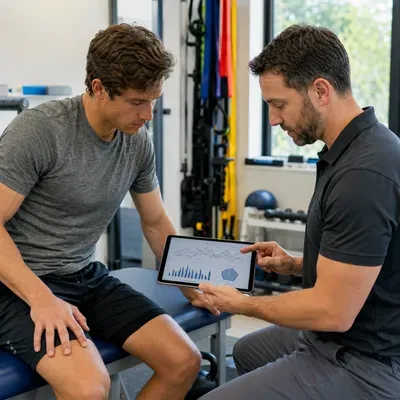
The truth is that most bloggers ignore this:
Tests are useful for identifying weaknesses. They highlight areas where confidence, strength, and mobility are still lacking.
Exact re-injury risk cannot be accurately predicted by tests. Safety is not ensured by a single score. According to a 2025 BJSM review, the limb symmetry measure by itself frequently overestimates preparedness.
Testing helps to lower uncertainty. It makes the choice more data-driven and less emotive. That's the aim.
When Should Return to Sport Testing Happen
Time is a floor, not a finish line. For ACL reconstruction, most protocols use a minimum of 6 to 9 months. But time alone is not enough.
A major 2020 study found that athletes who returned before 9 months had a much higher rate of new ACL injury. More recent 2025 data suggests that when athletes genuinely meet objective criteria, timing matters less. How you return may matter more than when.
Common thresholds to know:
- 90% limb symmetry index for strength and hop performance
- Full range of motion, no swelling or instability
- Psychological readiness score reflecting genuine confidence
- Graded sport exposure, with full practice before competition
For youth athletes, the bar is higher. A 2023 Delphi statement on adolescent ACL rehab recommended longer rehab and several weeks of full group training before competition clearance.
Ready to stop guessing and get a clearer path back to sport? Book a return to sport testing evaluation with AthleteRx Performance Rehab and find out what your body is truly ready for before you return to practice or competition.
The Bottom Line
Return to sport testing does not eliminate risk, but it gives athletes, parents, and coaches better information before the next step. At AthleteRx Performance Rehab, athletes work with board-certified, fellowship-trained sports physical therapists who bring 10+ years of experience and pro-level rehab methods into care for active people in Parker, Plano, Allen, and nearby North Dallas communities. Book your return to sport evaluation with AthleteRx Performance Rehab and get a clear, test-based plan before you step back onto the field, court, track, or gym floor.