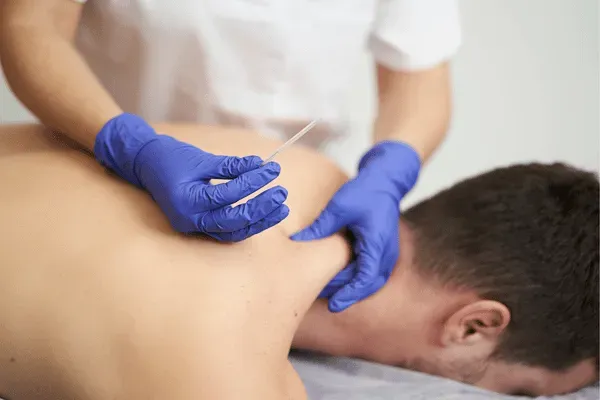
If you're an athlete experiencing muscle soreness or tightness, dry needling therapy could be the solution. A 2025 systematic review in Sports Medicine discovered that this drug-free sports treatment technique targets muscle knots, or trigger points, and can help reduce pain and promote recovery. Physical therapists use tiny needles to relieve trigger points and restore movement. No injections. No medicines. Just quick, effective relief. Let's look at how this treatment works and why athletes trust it.
What Is Dry Needling Therapy?
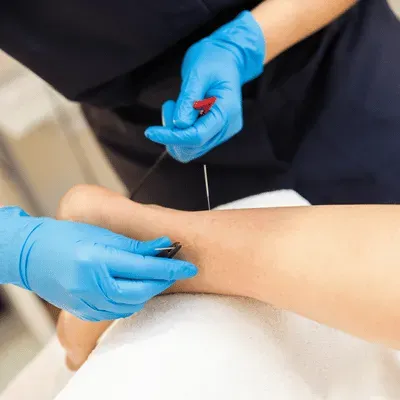
Dry needling therapy is a precise technique for treating muscle pain and stiffness. A trained provider inserts ultra-fine needles into muscle knots (trigger points) to release tension. The American Physical Therapy Association defines it as a skilled intervention that targets neuromuscular problems. The needles are "dry" because nothing is injected.
This is not acupuncture. Acupuncture uses Eastern medical ideas to harmonize energy pathways. Dry needling therapy employs Western medical paradigms. It concentrates on muscular tissue and neural impulses. The purpose is simple: deactivate trigger points to increase movement.
Sports therapy teams frequently combine dry needling with exercises and stretching. This results in a comprehensive pain management plan. The result? Faster recuperation and improved performance.
How Does Dry Needling Work?
The treatment targets tight muscle bands that reduce blood flow and cause pain. When a needle enters a trigger point, it creates a twitch response. This quick muscle spasm signals the knot is releasing. Blood flow returns to normal. The muscle relaxes.
Dry needling for pain relief works on two levels:
- Physical level: The needle releases tight muscle fibers
- Neurological level: It triggers endorphin release and reduces pain signals
According to Cleveland Clinic, dry needling uses solid needles with no medication injected, and it works by stimulating trigger points to help reduce pain, improve mobility, and increase blood flow. Some people feel improvement almost immediately, while others need more than one session. A 2025 randomized clinical trial in the Journal of Manual & Manipulative Therapy also found improved blood flow and shoulder range of motion after dry needling in people with shoulder pain.
Pain Relief Benefits for Athletes
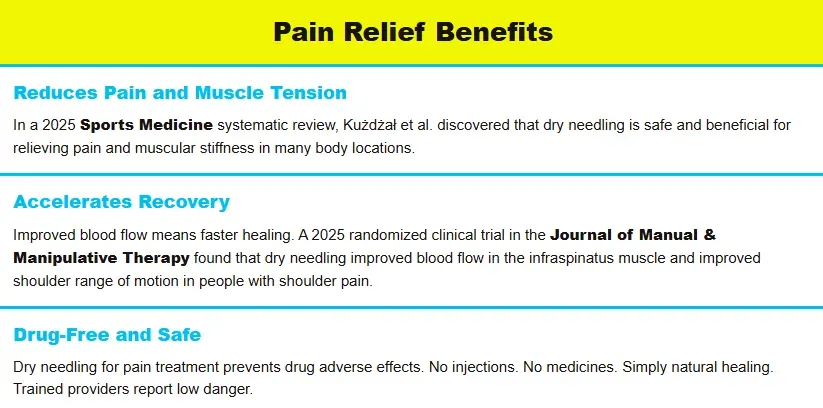
Sports dry needling offers powerful benefits for active people. Here's what research shows:
Reduces Pain and Muscle Tension
In a 2025 Sports Medicine systematic review, Kuźdżał et al. discovered that dry needling is safe and beneficial for relieving pain and muscular stiffness in many body locations. Athletes reported:
- Less stiffness in the muscles
- Enhanced adaptability
- An increased range of motion
- Less rigidity
Accelerates Recovery
Improved blood flow means faster healing. A 2025 randomized clinical trial in the Journal of Manual & Manipulative Therapy found that dry needling improved blood flow in the infraspinatus muscle and improved shoulder range of motion in people with shoulder pain. Studies prove dry needling speeds up rehab:
- Patients who had ACL surgery demonstrated improved knee function (Sports Medicine study)
- Patients with shoulder impingement reported less pain and more mobility
- According to a meta-analysis, athletes with low back pain experienced less pain and more mobility
Drug-Free and Safe
Dry needling for pain treatment prevents drug adverse effects. No injections. No medicines. Simply natural healing. Trained providers report low risk of complications. Some people have moderate soreness for a day or two.
For competitive athletes, this matters. You avoid substances and lengthy recovery times. Sports dry needling gets you back to training faster.
Common Injuries Treated with Dry Needling
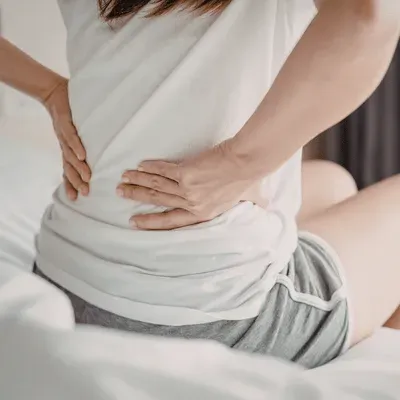
Sports therapy providers use this technique for many conditions:
- Muscle strains: Hamstring pulls, calf strains, and tight quads
- Tendonitis: Tennis elbow, rotator cuff problems, and Achilles issues
- Back and neck pain: Tightness in the upper trapezius and lumbar region
- Joint pain: Shoulder impingement, hip pain, and knee problems
- Headaches: Tension headaches caused by tight neck and shoulder muscles
- Overuse injuries: Shin splints and IT band syndrome
- Post-surgical rehabilitation: Getting your knee or ankle moving again after surgery
Remember: dry needling therapy works best as part of a complete treatment plan. Combine it with corrective exercises and stretching for optimal results.
What to Expect During Treatment
Your first sports dry needling session is straightforward. Here's the process:
- Evaluation: Your trigger points are identified by the provider
- Needle insertion: Incredibly fine needles target tight areas
- Twitch response: A brief contraction of your muscles may occur (this is a good sign!)
- Needle removal: Each point is completed in a matter of seconds
- Immediate relief: As tension releases, muscles relax
Most people barely feel the needle enter. When it hits the trigger point, you might feel a dull ache. This lasts only a moment. Sessions are quick, and multiple points can be treated at once.
Stay hydrated and keep moving after your treatment. Light activity can help ease any soreness. Many athletes say dry needling is essential for managing long-term muscle issues.
Take the Next Step Toward Pain-Free Performance
At AthleteRx Rehab, we use dry needling therapy as part of a full sports rehab plan to help reduce pain, ease muscle tension, and support faster recovery. Research consistently shows dry needling can reduce pain and improve function, especially when combined with corrective exercise and manual therapy.
Whether you're dealing with a nagging muscle strain, post-surgical stiffness, or chronic tightness that won't respond to stretching, our licensed physical therapists are here to help. No referral needed, and same-week appointments are available.