Functional movement training is one of the most effective strategies to gain real-world strength. It is concerned with how your body moves rather than its appearance. This technique produces meaningful benefits, whether you're an athlete recovering from an injury or someone who wants to keep active without pain.
What Is Functional Movement Training?
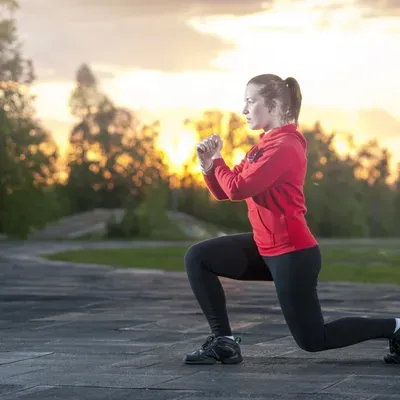
Functional movement training uses multi-joint exercises that copy real-life and sport-specific motions. Instead of training one muscle at a time, it works several muscles and joints together.
Common examples include:
- Squats and lunges build lower body strength and hip mobility
- Pushing and pulling movements train the upper body in real patterns
- Rotational and balance drills improve coordination and core control
Your body learns to function as a unit through these exercises. Better control is the result, whether you're running on a field, lifting a box, or climbing stairs.
How Functional Movement Training Boosts Performance and Prevents Injuries
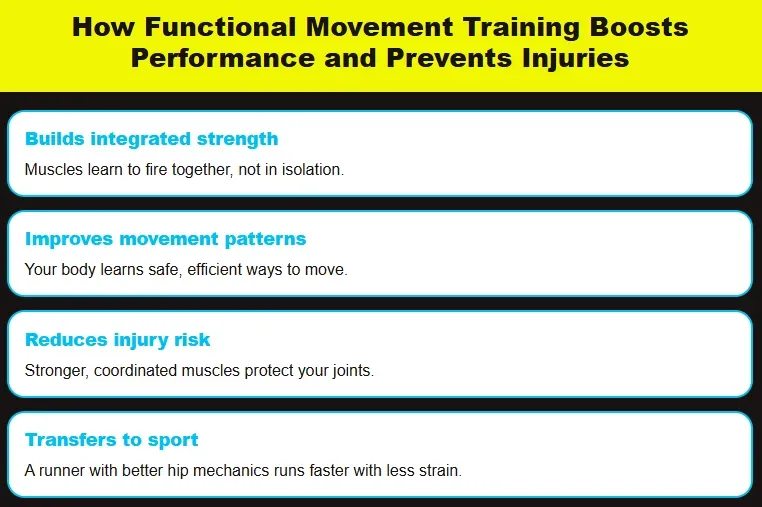
According to Xiao et al.'s 2025 systematic review, functional training improves both physical and technical performance in athletes across many sports. Here's why it works:
- Builds integrated strength: Muscles learn to fire together, not in isolation
- Improves movement patterns: Your body learns safe, efficient ways to move
- Reduces injury risk: Stronger, coordinated muscles protect your joints
- Transfers to sport: A runner with better hip mechanics runs faster with less strain
Functional movement training isn't just for athletes. Everyday people benefit too — carrying groceries, playing with kids, or staying pain-free at work all get easier.
The Role of Sports Rehabilitation
Sports rehabilitation covers prevention, recovery, and performance for active people. Functional movement training plays a central role in sports rehab programs.
Here's what sports therapy looks like in practice:
- Following a knee injury, a runner practices single-leg balance and lunge techniques
- A baseball pitcher rebuilds shoulder strength through coordinated hip-to-arm workouts
- A weekend hiker works on ankle stability before returning to the trail
Sports rehabilitation helps athletes restore power and confidence rather than just managing pain. Recovery is faster and more complete when combined with functional movement training.
Corrective Exercise Therapy: Fixing the Root Cause
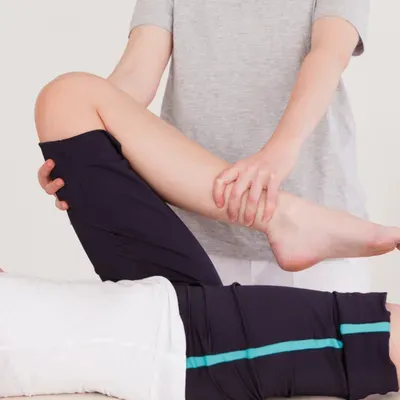
Corrective exercise therapy identifies and corrects the movement problems that lead to injury. Instead of treating symptoms, it targets why pain or poor movement happens in the first place.
What the Process Looks Like
- A therapist assesses your movement and finds weak or tight areas
- They prescribe targeted drills like stretches, stabilization work, or posture exercises
- Those corrections improve joint stability, mobility, and movement quality overall
For example: stiff hips and weak glutes put stress on your lower back. Corrective exercise therapy addresses the hips and glutes first, making every squat, lunge, and deadlift safer and stronger.
When combined with functional movement training, corrective exercise therapy creates a solid foundation. You move better, hurt less, and perform at a higher level.
Move Better. Stay Active. Perform at Your Best.
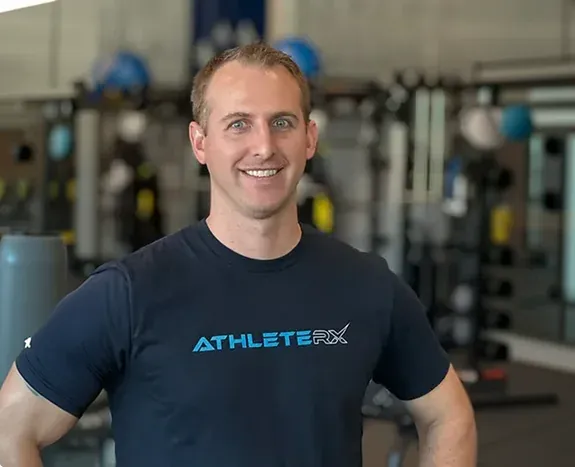
Functional movement training, sports rehabilitation, corrective exercise therapy, and sports therapy all play a role in helping you move better and stay active. At AthleteRx Performance Rehab, care is led by Dr. Ben Volkman, PT, DPT, SCS, FAAOMPT, CSCS.
The clinic brings more than 10 years of experience, board-certified and fellowship-trained sports physical therapy, and treatment methods used with NFL, MLB, and NBA athletes. That level of training gives patients a stronger path back to movement, performance, and long-term resilience.
Don't settle for a quick fix. Book your movement assessment with AthleteRx today and start a one-on-one, performance-based rehab plan built to reduce pain, restore movement, and get you back to doing what you do best. No referral needed, and same-week appointments are available.