
How long does a sprained ankle take to heal? A mild sprain may heal in 1 to 3 weeks. A moderate sprain usually takes 3 to 6 weeks, while a severe injury can take 6 to 12 weeks or longer. The tricky part is knowing when your ankle is strong enough for normal activities again.
At AthleteRx in Parker, Texas, we help athletes work through recovery and prepare for a safe return to their sport.
How Long Does a Sprained Ankle Take to Heal by Grade?
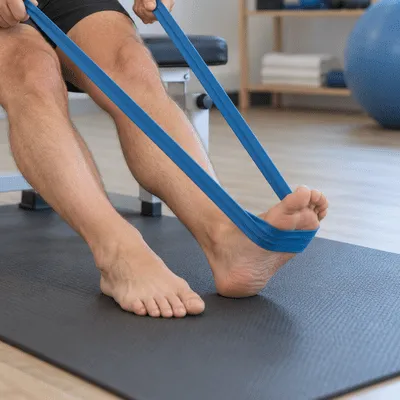
An ankle sprain happens when the ligaments holding your ankle together stretch too far or tear. According to the American Academy of Orthopaedic Surgeons (AAOS), about 90% of ankle sprains happen when the foot rolls inward.
These inward rolls usually injure the anterior talofibular and calcaneofibular ligaments on the outside of the ankle.
They are also very common. AAOS calls ankle sprains the number one reason for missed participation in athletics. A 2025 study in the journal Orthopedics estimated that 7.4 million ankle sprains were treated in U.S. emergency departments from 2010 to 2024. Teens aged 15 to 19 had the highest rate, and athletic activity accounted for about a third of all cases.
Doctors divide these injuries into three grades based on how much damage has occurred.
| Grade | What Happens | Recovery Time |
|---|---|---|
| Grade 1 | Slight stretching and microscopic tears in the ligament, with mild swelling | 1 to 3 weeks |
| Grade 2 | Partial tear with swelling and some joint looseness | 3 to 6 weeks |
| Grade 3 | Complete tear with significant swelling and instability | 6 to 12 weeks or longer |
These timelines are a guide, not a deadline. Even when the swelling has gone down, your ankle may not be ready for running or jumping. AAOS notes that in most cases, swelling and pain last 2 to 3 days, and a full rehab program may take just 2 weeks for a minor sprain or up to 6 to 12 weeks for a more severe one.
Grade 2 ankle sprain recovery time also depends on how well you regain movement and strength. The ligament needs time to heal, but resting alone won't restore full ankle function.
AAOS says nearly all isolated low ankle sprains can be treated without surgery. Even a complete tear can heal without surgical repair when it is immobilized and rehabilitated appropriately.
What If You Have a High Ankle Sprain?
Not every sprain affects the outside of the ankle. A high ankle sprain involves the ligaments connecting the two bones in your lower leg, just above the joint.
These sprains are less common, but they show up more often in contact sports. In one NFL team's records over 15 seasons, high ankle sprains made up about 40% of all ankle sprains, according to a review in the Journal of Athletic Training.
High ankle sprain recovery time is often longer because these ligaments help keep the ankle stable under weight. Some people need extra imaging or a longer rehab program before returning to sports.
A review published at the end of 2025 pooled 14 studies of 901 elite athletes with high ankle sprains. Overall, 96% returned to their sport after an average of about 58 days. Harvard Health Publishing adds that these sprains are especially likely to lead to chronic ankle instability and repeat sprains.
Why Do Some Ankle Sprains Take Longer to Heal?
You might know someone who recovered from an ankle sprain in two weeks. Meanwhile, you're still dealing with soreness after a month.
Several things can explain the difference:
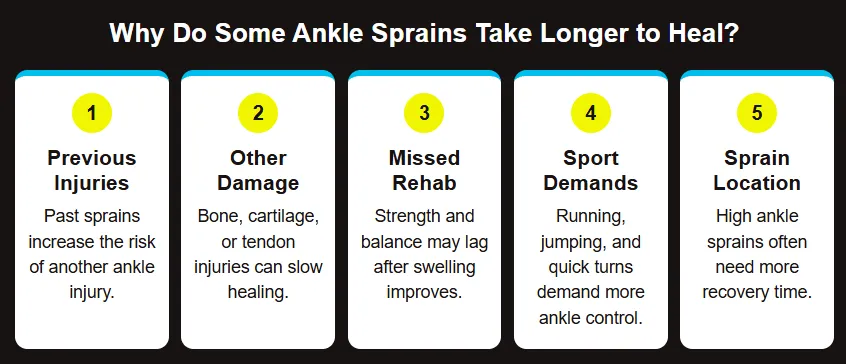
- Previous injuries: An ankle that's been sprained before is more likely to get injured again. In a study of 9,811 military cadets, those with a past ankle sprain had about 3.5 times the risk of another one.
- Other damage: Injuries to nearby bones, cartilage, or tendons can slow healing.
- Missing rehab: Swelling may disappear before your strength and balance return. AAOS calls incomplete rehabilitation the most common cause of chronic ankle instability after a sprain.
- Type of sport: Basketball, soccer, and tennis put more stress on the ankle than walking. Basketball alone accounted for 15.8% of the ankle sprains treated in U.S. emergency departments from 2010 to 2024.
- Location of the sprain: High ankle injuries often take more time to recover.
Repeated sprains can lead to chronic ankle instability. This means your ankle may give way unexpectedly, especially when you turn, land, or change direction.
This problem is more common than many people expect. A review in the Journal of Athletic Training cites research that found chronic ankle instability in 40% of people one year after a first-time sprain on the outside of the ankle.
AAOS warns that poor recovery can leave people dealing with ongoing weakness and repeat injuries.
Mayo Clinic adds that undertreated sprains, returning to activity too soon, and repeated sprains can also lead to ongoing ankle pain and arthritis in the ankle joint.
How Should You Rehab a Sprained Ankle?
During the first few days, your ankle may be swollen and painful. Reducing that swelling matters, but you'll also need to get the joint moving again.
AAOS recommends working through recovery in stages. Its three-phase program moves from rest and swelling control to range of motion, strength, and balance work, to a gradual return to activity.
- Manage pain and swelling. In the first few days, give your ankle a break from anything that makes it hurt more. Ice, compression, and elevation can help bring the swelling down. Mayo Clinic recommends using the R.I.C.E. method for the first two to three days, with ice applied for 15 to 20 minutes every 2 to 3 hours while you're awake. Always place a thin towel between the ice and your skin, and talk to your doctor before icing if you have diabetes, vascular disease, or reduced skin sensation.
- Start moving again. Once the pain begins to settle, gently start moving your ankle and put weight on it as much as you can tolerate. If your doctor recommends a brace or boot, follow that advice. According to AAOS, early weight-bearing is usually helpful, and spending too long immobilized can lead to stiffness during recovery.
- Work on strength. Begin with easy exercises that target the muscles around your ankle, then gradually increase the difficulty as it starts to feel better. If exercises like toe raises still hurt too much, water-based exercises can be a good alternative. AAOS notes that resistance can be added slowly as your ankle gets stronger.
- Practice balance. Balance training is an important part of recovery. Start by standing on your injured foot near a wall or chair so you have support if needed. As you get steadier, try holding the position longer. A more challenging version recommended by AAOS is standing on that foot with your eyes closed. Balance boards may also be useful at this stage.
- Ease back into sports. Before jumping back into full activity, start with light jogging and then progress to small hops or gentle direction changes. Avoid doing too much too soon while your ankle still feels weak. AAOS recommends beginning with movements that do not involve twisting or turning, then working up to sharper cuts like those used in tennis, basketball, or football. Running figure-8s in gradually smaller patterns is one example of an agility drill that can help.
Some severe sprains may still need a short period of protection with a cast or brace. AAOS notes that some Grade 3 sprains may need around 10 to 14 days of support. If you need to return to work or sports early, taping or bracing the ankle may also be recommended.
Mayo Clinic's updated 2026 guidance also highlights how important exercise is for getting back ankle strength and movement. Strengthening the muscles around the ankle helps support the joint and may lower the risk of spraining it again. Balance exercises, such as standing on one leg, also help improve coordination and control.
Other research supports the same approach. Harvard Health Publishing notes that people often get back to their usual activities faster when treatment focuses on restoring ankle function rather than keeping the ankle immobilized for too long. Support from braces, taping, or elastic bandages can help during this process. A 2018 international clinical guideline published in the British Journal of Sports Medicine also favors supervised exercise-based rehab over passive treatments because it does more to restore ankle stability. Surgery is generally reserved for cases that do not improve with a full course of exercise-based treatment.
Physical therapy for ankle sprain can help when you're unsure how much activity is safe. Our sports physical therapy services focus on getting your ankle ready for the demands of your sport.
How Can You Tell If You're Ready to Play Again?
Being able to walk without limping is a good sign. But can you land on that foot after a jump? What happens when you make a sudden turn?
These movements matter when deciding whether you're ready to compete again.
Many athletes go back before they are. The researchers behind the PAASS framework note that more than half of people with this kind of sprain don't seek formal medical treatment, and many return to sport before their injury-related limitations resolve. They also cite research showing that 71% to 75% of U.S. high school athletes were cleared to return within 3 days of the injury.
A British Journal of Sports Medicine study brought together 155 health professionals working in elite field and court sports to develop the PAASS framework. It looks at five parts of recovery.
| What to Check | Why It Matters |
|---|---|
| Pain | Your ankle shouldn't become painful during or after activity |
| Strength and movement | You need enough motion and power for your sport |
| Confidence | You should feel comfortable trusting the injured ankle |
| Balance | Your ankle needs to stay steady when you move |
| Sports skills | You should manage jumps, quick turns, and full practice drills |
A July 2026 Journal of Clinical Medicine study examined Ankle-GO data from 6,934 patients. Researchers found that 20.4% had already returned to sport before their first assessment. The study didn't determine whether those athletes were ready to play.
The Ankle-GO is a 25-point score that combines four balance and hop tests with two questionnaires, and it is usually given by a physical therapist. The researchers also reported that most patients' first balance and hop results fell below published return-to-sport cut-offs.
Why does that matter? In a two-year study published in Sports Medicine-Open, patients scoring below 8 points two months after their sprain had approximately 8.6 times higher odds of another sprain within two years. One in three patients in that study had a repeat sprain within two years.
That's one reason checking ankle function matters. Mayo Clinic notes that a physical therapist may use specific movement tests to make sure your ankle is strong and stable enough for the sports you play. At AthleteRx, our return-to-sport rehabilitation helps athletes work toward the strength and control their activities require.
When Should You See a Doctor?
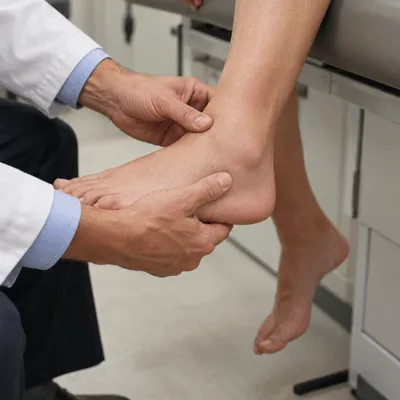
Not every twisted ankle needs a trip to the doctor. But if the pain is making it hard to walk or something doesn't feel right, getting it checked is a good idea.
Watch for these signs:
- You can't manage four steps after hurting your ankle.
- Pressing on the bony parts of your ankle causes sharp pain.
- Notice severe swelling, numbness, or an ankle that looks out of shape.
- Have pain above the ankle joint.
- Still have pain or swelling that isn't improving after a few days.
- Pain continues for more than 4 to 6 weeks. AAOS says this may be a sign of a chronic ankle sprain.
The first two signs reflect the Ottawa ankle rules, a checklist clinicians use to decide whether an ankle injury needs an X-ray. A BMJ review of 27 studies with 15,581 patients found that the rules picked up almost 100% of ankle and midfoot fractures and could cut unnecessary X-rays by 30% to 40%. The review also notes that fewer than 15% of people with ankle sprains who get X-rays in emergency departments turn out to have a fracture.
A fracture can sometimes feel like a bad sprain. AAOS notes that an MRI isn't required to diagnose an ankle sprain, though imaging may help when doctors suspect more serious damage. According to AAOS, an MRI may be ordered to check nearby ligaments, cartilage, and tendons when there are signs of a high ankle sprain or when symptoms last beyond 6 to 8 weeks despite treatment.
Timing can matter, too. The 2018 British Journal of Sports Medicine guideline notes that the severity of ligament damage can be assessed most reliably with a physical exam 4 to 5 days after the injury. That said, Harvard Health Publishing advises contacting a clinician right away if pain and swelling are severe, the ankle feels numb, or you can't bear weight.
The Bottom Line
A sprained ankle may stop hurting before it's fully ready for sports. Give it time to heal, then make sure your strength and balance have caught up. AthleteRx in Parker works with athletes from Plano, Allen, Lucas, Murphy, Wylie, and nearby Collin County communities. Want to get back to your sport without guessing if your ankle is ready? Book an evaluation with AthleteRx today.