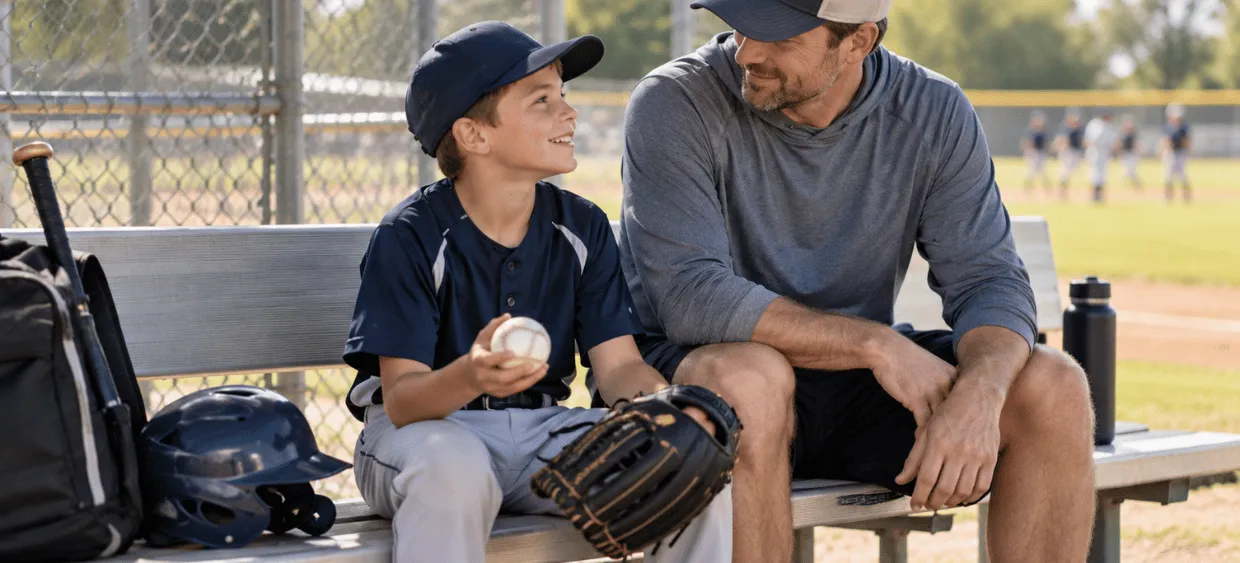
Little league elbow can sneak up on young baseball players who throw often. It rarely announces itself with one bad pitch. Usually, it builds quietly across a season of games, practices, private lessons, and weekend tournaments.
It generally starts as pain along the inside of the elbow during or after throwing. Some players also notice swelling, stiffness, or a drop in throwing speed. Others never mention pain at all. They simply start short-arming their throws, ask to come out of the game, or rub the elbow between innings.
These signs should not be brushed off as normal soreness. Ordinary soreness settles after a day or two of rest. Pain that returns every time the arm goes overhead is a different problem.
Catching the problem early can keep a minor injury from becoming harder to manage. In many cases, it is the difference between a few weeks of managed rest and a season that ends early.
What Is Little League Elbow?
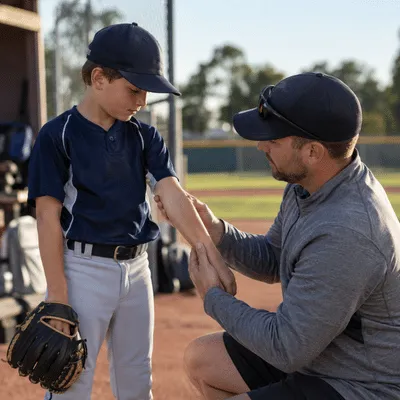
Parents often ask, What is little league elbow?
The medical name is medial epicondylar apophysitis. It happens when repeated throwing puts too much stress on the growth plate inside the elbow.
The throwing motion is the reason. As the arm whips forward, the inside of the elbow is pulled apart while the outside is compressed. A mature elbow spreads that load across bone, ligament, and tendon. A growing elbow does not.
That area is still developing in children and young teens. Their growth plates are also more vulnerable than the nearby muscles and ligaments.
The growth plate is the weak link in the chain, so it is the tissue that gives way first. It stays open through the elementary and middle school years and usually closes during the mid-teens, which is why this injury belongs to young throwers in particular.
The condition is an irritation of that growth plate rather than a tear. That is encouraging early on. It also means the tissue under stress is still forming, which is why the problem deserves a response rather than a wait-and-see approach.
The American Academy of Pediatrics notes that pitchers face the greatest risk. Still, the problem can affect catchers, infielders, and outfielders who throw often.
Catchers deserve particular attention. A catcher makes a firm throw back to the mound on nearly every pitch, and those throws rarely appear in anyone's count.
What Warning Signs Should Parents Watch For?
Pain is the most common warning sign. A young player should not keep throwing and hope it goes away.
Younger athletes often describe it vaguely. Words like tight, tired, or weird are worth taking as seriously as the word painful.
Watch for these symptoms:
| What you notice | What to do |
|---|---|
| Pain on the inside of the elbow | Stop throwing and watch the symptoms |
| Pain with swelling | Have the elbow checked |
| A painful pop | Stop playing and seek medical care |
| Numbness or tingling | Seek medical care |
| Trouble bending or straightening the arm | Have the elbow assessed |
Some signs show up in how a player moves rather than in what they say. A dropped arm slot, a shorter or softer throw, reluctance to make the long throw across the diamond, or a habit of icing the elbow after every outing all point in the same direction.
Continued throwing can put even more stress on the growth plate. In more serious cases, bone changes or loose fragments may develop.
Is Little League Elbow the Same as a UCL Injury?
No. They involve different parts of the elbow.
Little league elbow affects a growth plate that has not fully matured. A UCL injury affects the ligament that helps steady the inner elbow during throwing.
It is the injury most baseball parents have heard of, and it is usually the reason inner elbow pain worries them in the first place.
The difference comes down to maturity rather than force. Both injuries trace back to the same repeated stress on the inside of the elbow. In a young thrower whose skeleton is still growing, the growth plate gives way before the ligament does. Once that growth plate closes, the ligament becomes the tissue most likely to be injured.
Studies have found links between long-term inner elbow changes and signs of UCL stress in older players. That does not mean a child with little league elbow will develop a UCL tear. It does mean that throwing workload built up in youth baseball follows a player into high school and beyond.
The important point is simple. Inner elbow pain in a young thrower deserves attention.
Why Does Little League Elbow Happen?
Most cases come down to throwing more than the arm can handle. It is a volume problem far more often than a mechanics problem, although tired mechanics make the volume harder to absorb.
Risk can rise when a player has:
- Too many throws between games, practices, lessons, and showcases
- Too little rest between outings
- No real off-season from throwing
- Several teams are using the same player as a pitcher
- Pain or fatigue that gets ignored
Game pitch counts only tell part of the story.
Warm-up throws, bullpen sessions, practice, private lessons, and throws from other positions also place stress on the arm. Parents and coaches should look at the full weekly workload.
Even if a player completes a weekend far below the official limit, they may still have thrown hundreds of times. The long toss, the infield repetitions, the backyard throws, and the flat ground work were all ignored.
How Much Pitching Is Too Much?
Little League Baseball uses daily pitch limits based on age.
| League age | Daily maximum |
|---|---|
| 6–8 | 50 pitches |
| 9–10 | 75 pitches |
| 11–12 | 85 pitches |
| 13–16 | 95 pitches |
Rest matters too. Players aged 14 and younger who throw 66 or more pitches need four days of rest under Little League rules.
The threshold shifts for older players. At league ages 15 and 16, four days of rest are required after 76 or more pitches. Little League also states that no player may pitch on three consecutive days at any age.
Yearly workload also deserves attention.
MLB Pitch Smart recommends that players ages 9 to 12 stay under 80 innings within 12 months. It also advises taking at least four months away from throwing each year.
Research backs up the concern about heavy workloads. A 10-year study published in the American Journal of Sports Medicine found that youth pitchers who exceeded 100 innings in a year had about 3.5 times the risk of serious throwing injury.
Pitch limits help, but they are not a guarantee. Pain, fatigue, and total throwing volume still matter. The rules set a ceiling for a single game. They were never written to describe a safe week.
Little League Elbow Treatment and Recovery
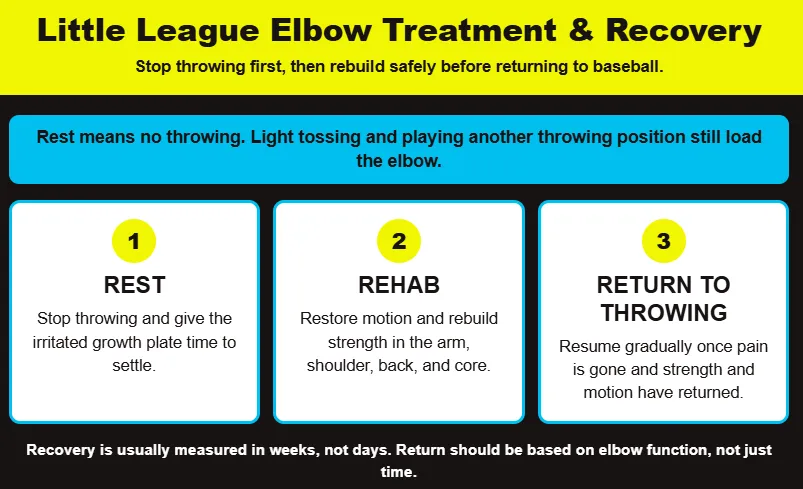
The first step in Little League elbow treatment is usually simple: stop throwing.
Rest here means no throwing at all. Light tossing, catch in the backyard, and a few weeks at shortstop all keep loading the same growth plate. The rest period is usually measured in weeks rather than days.
From there, care generally moves through three stages:
- Rest. Give the irritated elbow time to settle.
- Rehab. Restore motion while building strength in the arm, shoulder, back, and core.
- Return to throwing. Start gradually after pain is gone and strength and motion have returned.
A doctor may recommend a Little League elbow X-ray if a growth plate or bone injury is suspected. X-rays can reveal changes around the growth plate or loose bone fragments.
A normal X-ray does not always explain ongoing elbow pain. The physical exam and symptoms still matter.
Additionally, there isn't a single Little League elbow recovery time that works for every athlete. The course of a more severe growth plate injury will differ from that of a mild case. The timeline is influenced by age, position, the length of time the pain went unreported, and the degree of throwing that persisted after it began.
Return to baseball should depend on how the elbow feels and functions, not simply how many weeks have passed.
Sports physical therapy can help restore strength and prepare a player for throwing again. AthleteRx offers sports rehab and return-to-sport testing for athletes in Parker, Plano, Allen, and nearby North Dallas communities.
How Can Parents Reduce the Risk?
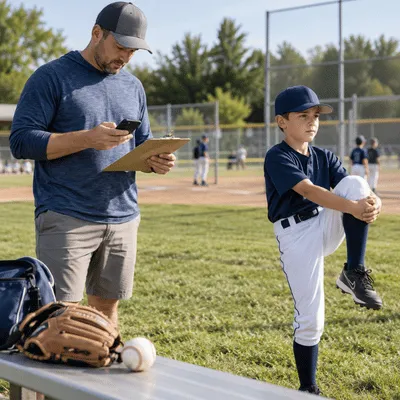
A few simple habits can make throwing workloads easier to manage:
- Keep track of pitches and other throws.
- Follow pitch count and rest guidelines.
- Give young arms at least four months away from throwing each year.
- Limit participation to one team per season.
- Ask your child about arm fatigue or discomfort regularly.
- Remove the pressure to pitch through pain.
Parents can also talk with coaches about total throwing volume. Most youth coaches welcome that conversation, especially when it comes with data.
A tracking app or simple notebook can help parents and coaches see the full weekly load. That information makes it easier to adjust before a problem develops.
Little league elbow does not have to derail a season or a career. Early recognition, appropriate rest, and gradual return make most outcomes favorable.
AthleteRx works with young athletes in Parker, Plano, Allen, and nearby North Texas communities. The clinic provides sports physical therapy and return-to-sport testing for baseball players managing throwing injuries.
Texas law allows eligible physical therapists to begin care without a referral for up to 30 calendar days. Insurance plans may have separate rules, so review your benefits before treatment.
Ready to get back on the field safely? Book Now with AthleteRx Performance Rehab for a sports physical therapy assessment and a return-to-throwing plan tailored to your young athlete's needs.