
Runner's knee can be frustrating. The pain settles, you start running again, and before long, it returns. That pattern is common, and it does not mean you are doing rehab wrong. Patellofemoral pain has a habit of lingering.
For many runners, the answer is not another long break. Progressive patellofemoral pain syndrome exercises and better control of running load can help the knee handle more over time.
The aim is simple: begin at a level your knee can manage comfortably, then increase the demand step by step.
What Is Runner's Knee?
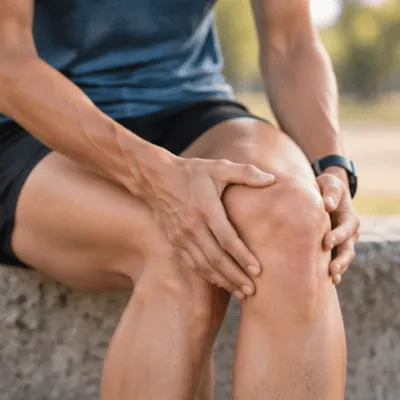
Runner's knee usually refers to patellofemoral pain. The discomfort is felt around or behind the kneecap. It is normally a spread-out ache rather than a sharp point you can cover with a fingertip, and it tends to build during activity rather than arrive all at once.
Common runner's knee symptoms include:
- An ache around or behind the kneecap
- Pain when using stairs
- Pain during squats
- Discomfort while running, often on downhills
- Aching after sitting with the knees bent
Major swelling and true knee locking are not typical signs. If either happens, another knee problem may be involved.
Diagnosis is usually clinical. A history of your training and a few loaded knee tests are often enough, and imaging is not needed in most cases.
Why Does Runner's Knee Keep Coming Back?
There is no single cause of runner's knee. Training load, strength, movement, sleep, and other factors can all affect symptoms.
Two evidence and gap maps published in the Journal of Orthopaedic & Sports Physical Therapy in February 2026 show how lopsided the research still is.
The first mapped 36 prospective studies on risk factors: 22 looked at biomechanical factors, one at psychological factors, two at behavioral factors, and one at neurobiological factors.
The second mapped 307 randomized treatment trials and found that psychological factors, quality of life, and sleep were each measured in fewer than 10 percent of them.
For runners, trouble often starts after the knee is asked to do more than it is ready for.
That can happen after:
- A quick jump in weekly mileage
- Adding more speed work
- Running more hills
- Returning to full mileage after time off
- Changing several parts of training at once
Rest can make a sore knee feel better. But it does not prepare the knee for the same workload that caused trouble before.
Are Weak Hips Really the Problem?
Weak hips are not the whole story.
Hip exercises can be useful during rehab. Still, having weak glutes does not automatically mean they caused the pain.
A 2019 British Journal of Sports Medicine review found that hip weakness did not consistently predict future patellofemoral pain. One result actually linked greater hip-abduction strength with future pain in adolescents.
That review pooled 18 prospective studies covering 4,818 people, 483 of whom went on to develop the condition.
It also found that age, height, weight, body mass index, body fat, and Q angle did not predict who would develop it.
The one strength finding that did hold up ran the other way: quadriceps weakness was a risk factor in military recruits.
So there is little value in blaming one muscle.
A better rehab plan looks at the runner's strength, training habits, symptoms, and current tolerance.
It also helps to separate the two questions: What caused the pain, and what helps it now. Hip work can earn a place in rehab even if hip weakness was never the cause.
What Patellofemoral Pain Syndrome Exercises Help?
Exercise remains one of the main parts of treatment. Knee strengthening often forms the base, with hip exercises added when they are useful.
In a 2023 trial involving 200 people, knee-focused and hip-focused programs produced similar results.
There is no single exercise that every runner must do.
Common patellofemoral pain syndrome exercises include:
| Training Goal | Examples | How to Make It More Challenging |
|---|---|---|
| Knee strength | Sit-to-stands, leg press, knee extension | Add weight, reps, or range |
| Hip strength | Bridges, side steps, hip abduction | Add bands or single-leg work |
| Single-leg strength | Step-ups, split squats, lunges | Increase depth or resistance |
| Running capacity | Step-downs, calf raises, hops | Add reps, speed, or impact |
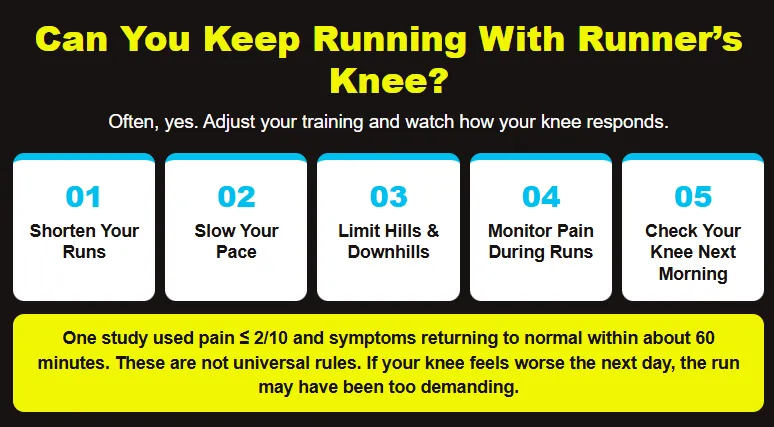
Pain during exercise is not always a sign of harm. Low levels of discomfort may be acceptable as long as symptoms do not worsen the next day.
One guideline suggests using a 0-to-10 pain scale and keeping exercise discomfort below a 3 or 4. If pain jumps above that level or lasts into the following day, adjust the intensity or range.
Can You Keep Running With Runner's Knee?
Many runners can continue at a reduced level. If pain stays below moderate and does not get worse, running may be manageable.
Signs that running may be tolerable:
- Pain stays mild during the run
- Symptoms do not increase the next day
- You are able to adjust pace, distance, or surface
Stop or pull back if:
- Pain becomes sharp or severe
- Your knee feels unstable or gives way
- Swelling appears after running
- Symptoms linger more than a day
Some runners benefit from shorter, more frequent runs at an easier pace. Others do better with two or three runs per week at a steady effort.
How Should You Build Back to Running?
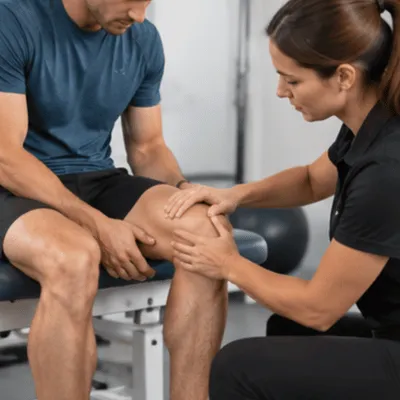
A gradual return allows the knee to adapt without being overwhelmed.
Common loading errors include:
- Returning to the full mileage you ran before pain started
- Adding distance and speed in the same week
- Increasing weekly volume by more than 10 to 15 percent
- Skipping rest days between hard efforts
A safer approach:
- Start at a distance and pace you can complete with little or no discomfort
- Add distance first, keeping pace easy
- Once you handle consistent mileage, introduce short bursts of faster running
- Monitor symptoms for 24 hours after each run
- Progress only when pain stays stable or improves
The 10 percent rule is a common guideline, but it is not strict. Some runners may need to increase more slowly, especially if the condition has been present for months.
Can Running Cadence Make a Difference?
Some studies suggest that increasing step rate by 5 to 10 percent can reduce forces at the knee. That may help certain runners, though it does not work for everyone.
A 2019 systematic review found that higher cadence reduced patellofemoral joint stress. Still, changing cadence takes time to feel natural, and some runners find it uncomfortable.
Test small adjustments during easy runs before applying the change across your training.
Do Braces, Taping, or Orthotics Help?
Some interventions may offer short-term benefit.
Patellar taping can reduce pain during activity for some people. The effect often fades over time, and taping is not a replacement for strengthening.
Foot orthotics may help runners with certain foot mechanics. A 2020 Cochrane review found moderate-quality evidence that orthotics reduce pain in the short term, but long-term benefit is less clear.
Knee braces designed for patellar tracking may provide comfort, but evidence for lasting improvement is limited.
None of these tools replace progressive loading. They may support rehab in the early stages, but strength and training adjustments do the most work.
When Should You Get Assessed?
Consider a formal assessment if:
- Pain has lasted more than a few weeks without improvement
- You have tried rest and basic exercises without progress
- Symptoms keep returning when you increase mileage
- You are unsure how to structure your rehab or return to running
AthleteRx works with runners in Parker, Plano, Allen, and nearby North Texas communities. The clinic provides strength testing, running assessments, and return-to-sport plans for athletes managing patellofemoral pain.
Texas law allows eligible physical therapists to begin care without a referral for up to 30 calendar days. Insurance plans may have separate rules, so review your benefits before treatment.
Runner's knee does not have to mean months on the sideline. A structured plan that balances exercise, running load, and recovery can help most runners return without constant setbacks.
Ready to move forward? Book Now with AthleteRx Performance Rehab for a sports physical therapy assessment and a return-to-running plan based on your symptoms and goals.